

What Is Chai Used For: Features, Reviews & Alternatives
BDD / TDD assertion library for node and the browser that can be delightfully paired with any javascript testing framework.
Editorially updated Oct 5, 2025
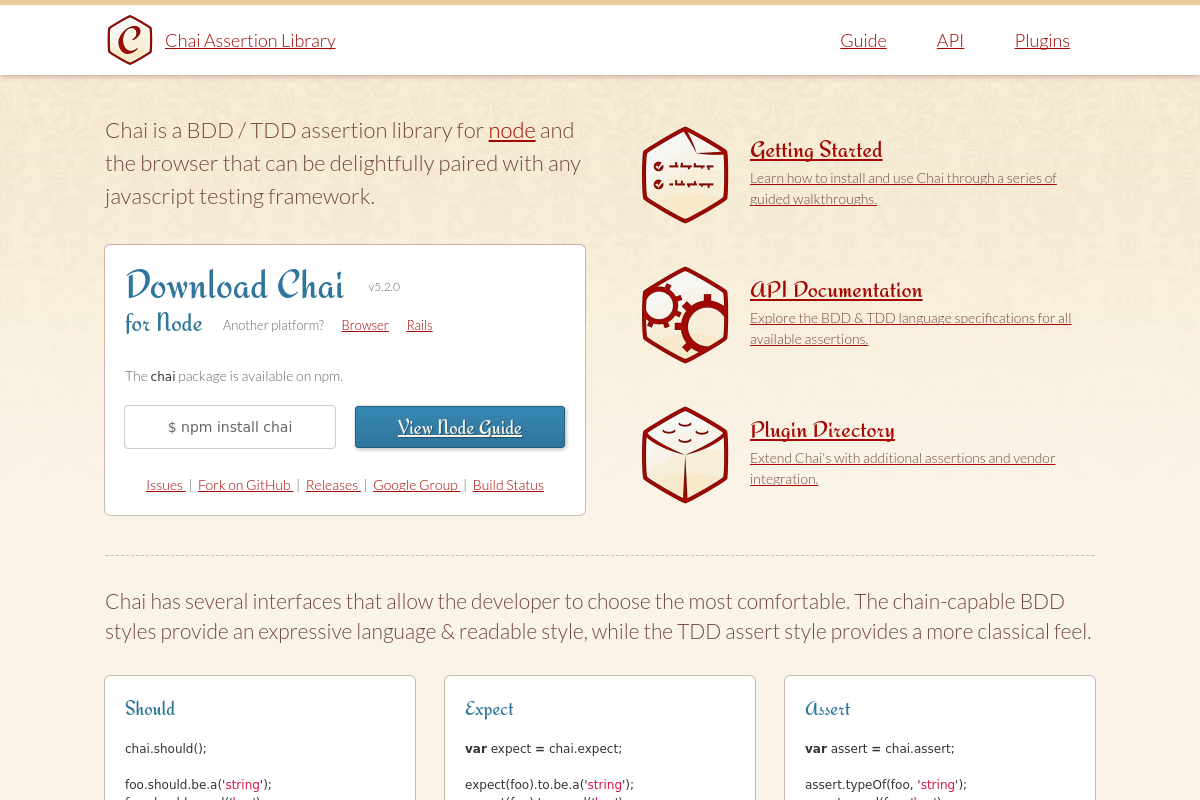
The overview
What Chai is for
1Core Capabilities
- BDD-style expect and should interfaces alongside a TDD-style assert API, so existing suites can keep the assertion vocabulary they already use
- Readable chained assertions for equality, type checks, keys, thrown errors, property paths, and collection length
- Runs in both Node and browser test environments, which helps shared packages keep one assertion layer across server and client checks
- Plugin-friendly extension model for promise assertions, spy integrations, and custom domain-specific matchers when core checks are not enough
Who it helps
Useful ways to use Chai
A practical path
Choose one assertion style
Pick expect, should, or assert based on the suite you already have, then keep that choice narrow so reviewers do not parse multiple assertion dialects in the same codebase.
External signals
Reviews & reputation
Aggregated review score
Chai performs best when teams prioritize clear task execution and operational repeatability and keep ownership explicit around repeatable team usage.
Quick answers
Frequently asked questions
1What kind of team usually gets the most value from Chai?⌄
Teams with runner-agnostic JavaScript suites, shared Node and browser coverage, or long-lived Mocha-based tests often benefit the most. It is especially useful when changing the runner would be easier than rewriting the assertion layer.
2When is Chai probably more layer than you need?⌄
If your runner already ships assertions and mocking primitives your team likes, adding Chai can introduce another syntax surface without solving a real problem. That tradeoff is worth checking before standardizing on it.
3Does Chai replace a test runner?⌄
No. Chai focuses on assertions. You still need a runner to execute tests, and many projects also pair it with separate mocking or spying tools.
4Can Chai cover async and spy-heavy tests by itself?⌄
Partly. Core Chai handles assertions, but promise-oriented syntax and spy assertions are commonly added through companion packages or adjacent test utilities.
5Is the chained style always easier to read?⌄
Not always. Short, intention-revealing chains read well, but very long chains can blur what actually failed. Most teams do better with a small assertion style guide.
Keep exploring