

What Is ServiceNow Customer Service Used For: Features, Reviews & Alternatives
Connects customer service with other departments.
Editorially updated Oct 5, 2025
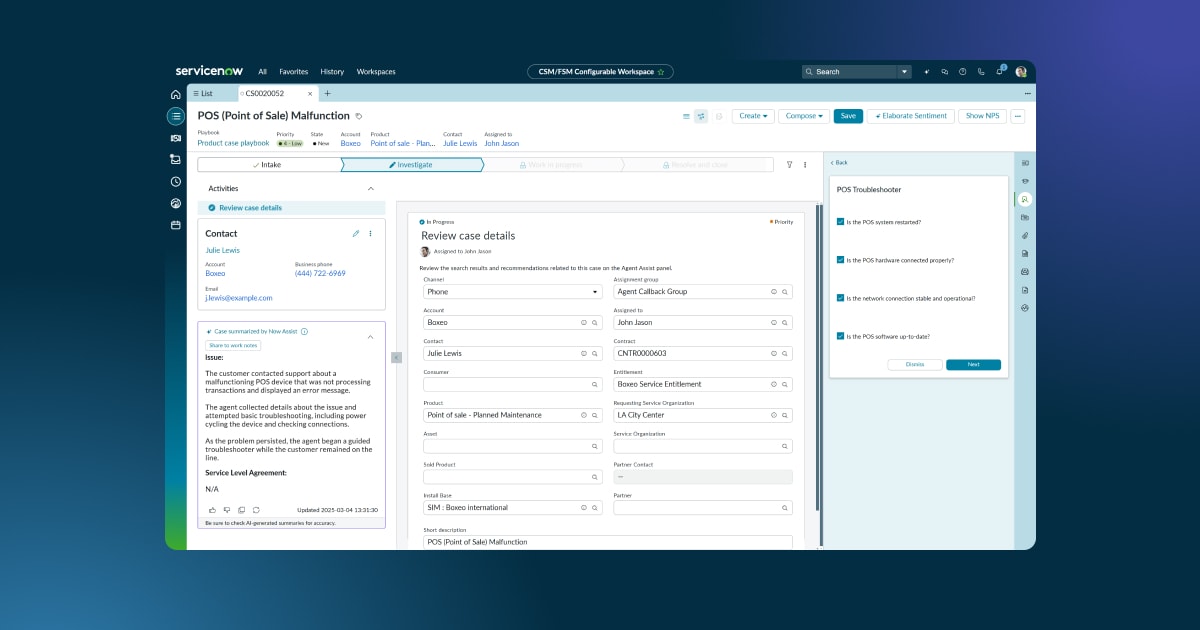
The overview
What ServiceNow Customer Service is for
1Core Capabilities
- Department-aware case routing that keeps ownership transitions explicit between customer support, engineering, billing, and operations
- Persistent case context that carries customer history, notes, and linked tasks so handoffs do not lose evidence
- Policy and permission surfaces to separate customer-facing updates from internal chat and investigative work
- SLA and priority controls tied to service targets, with visible state transitions for escalation and follow-through
- Template-driven playbooks for recurring issue families, helping support reuse proven resolution paths across repeat cases
Who it helps
Useful ways to use ServiceNow Customer Service
A practical path
Define cross-team case pathways
Create issue families (for example onboarding, billing disputes, enterprise access) and assign explicit fallback teams for each step of the support flow.
External signals
Reviews & reputation
Aggregated review score
ServiceNow Customer Service can deliver reliable outcomes for workflow completion, especially when rollout begins with a pilot focused on connects.
Quick answers
Frequently asked questions
1How do I know if this is a fit for my support model?⌄
It usually fits when your team repeatedly hands cases to operations, billing, and product teams and those handoffs currently lose context or take too long. If your cases mostly stay within one function, the complexity may be unnecessary.
2Can this replace every internal support queue or knowledge base tool?⌄
Usually not. It is better used as the coordination layer for customer-facing service cases, while specialist tools for CRM, chat, or documentation can remain in place if they already perform better in their niche.
3What is the key procurement question before adopting?⌄
Start with repeat cost versus repeat value: whether reduced context-loss rework and faster closure cycles justify seat count, onboarding effort, and ongoing administration over time. Ask for a pilot period with real issue volume before committing.
4What should not be routed through ServiceNow Customer Service?⌄
If an issue requires high-volume anonymous one-way announcements or purely internal task tracking with no customer contact, other internal systems may be simpler. Use this platform when customer outcome and inter-department ownership are the core problem.
5How can I assess collaboration boundaries before rollout?⌄
Map who needs to see customer-facing notes versus internal investigation notes, and test whether those boundaries remain stable in escalations. If teams routinely need different visibility levels during the same case, the platform is usually a good fit; if not, governance may be overengineered.
Keep exploring