

What Is Simplenote Used For: Features, Reviews & Alternatives
Lightweight, cross-platform note app.
Editorially updated Oct 25, 2025
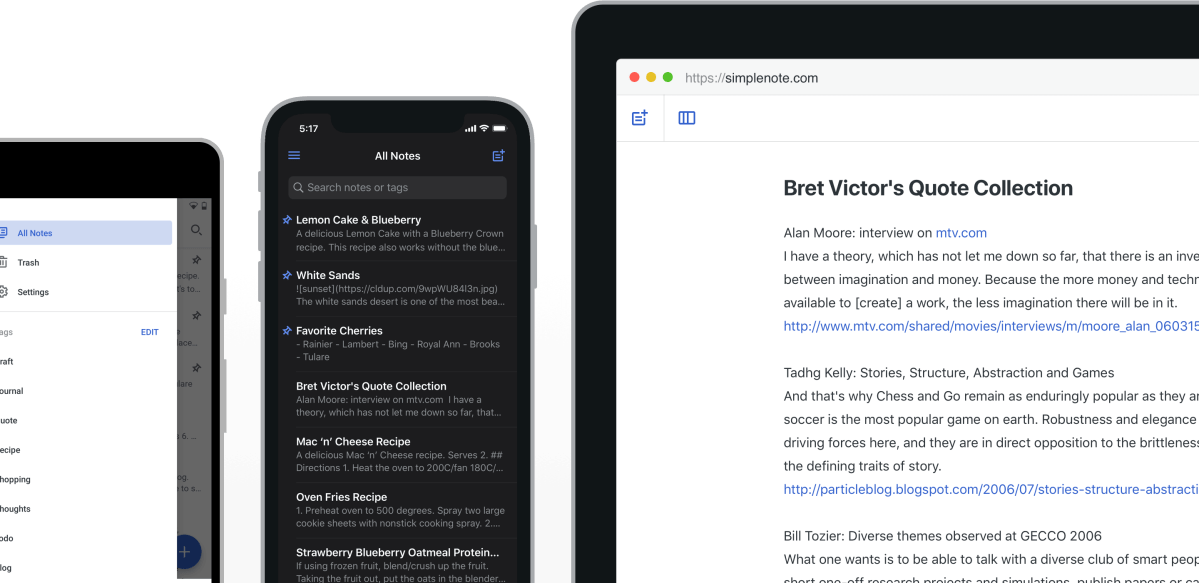
The overview
What Simplenote is for
1Core Capabilities
- Cross-platform sync across web, desktop, and mobile with a consistent plain-text editing model
- Tag-based organization for lightweight taxonomy management without folder sprawl
- Fast full-text search suited to high-volume retrieval of short notes and reference fragments
- Version history on notes, useful for rolling back edits and tracing idea evolution
- Markdown support for readable structure (headings, lists, links) while keeping notes portable
Who it helps
Useful ways to use Simplenote
A practical path
Define a Compact Tag Taxonomy
Start with 8-15 tags split by topic, source type, and project stage (for example: theory, dataset, draft, pending-review) to avoid uncontrolled tag growth.
External signals
Reviews & reputation
Aggregated review score
This pass shows Simplenote fitting strongest workflows where workflow completion quality is measurable and maintenance overhead and process drift controls are documented.
Quick answers
Frequently asked questions
1Is Simplenote enough for a full team knowledge base?⌄
For text-centric teams with simple structure needs, it may be sufficient. Teams needing permissions granularity, rich embeds, or database-like linking will likely need additional tools.
2How well does it handle long-form, heavily formatted documents?⌄
It is primarily optimized for lightweight text notes. Markdown helps with structure, but advanced page layout and rich media workflows are limited compared with document suites.
3Can it support rigorous research note workflows?⌄
It can support disciplined research capture if you enforce strong tagging, consistent titles, and citation habits. Complex bibliographic management usually requires a companion reference tool.
4What is the main operational risk after adoption?⌄
Tag entropy is the common issue: inconsistent naming reduces search precision over time. A small controlled vocabulary and periodic cleanup usually mitigate this.
Keep exploring