

What Is Amazon CodeWhisperer Used For: Features, Reviews & Alternatives
Machine learning-powered service that helps improve developer productivity by generating code recommendations.
Editorially updated Oct 5, 2025
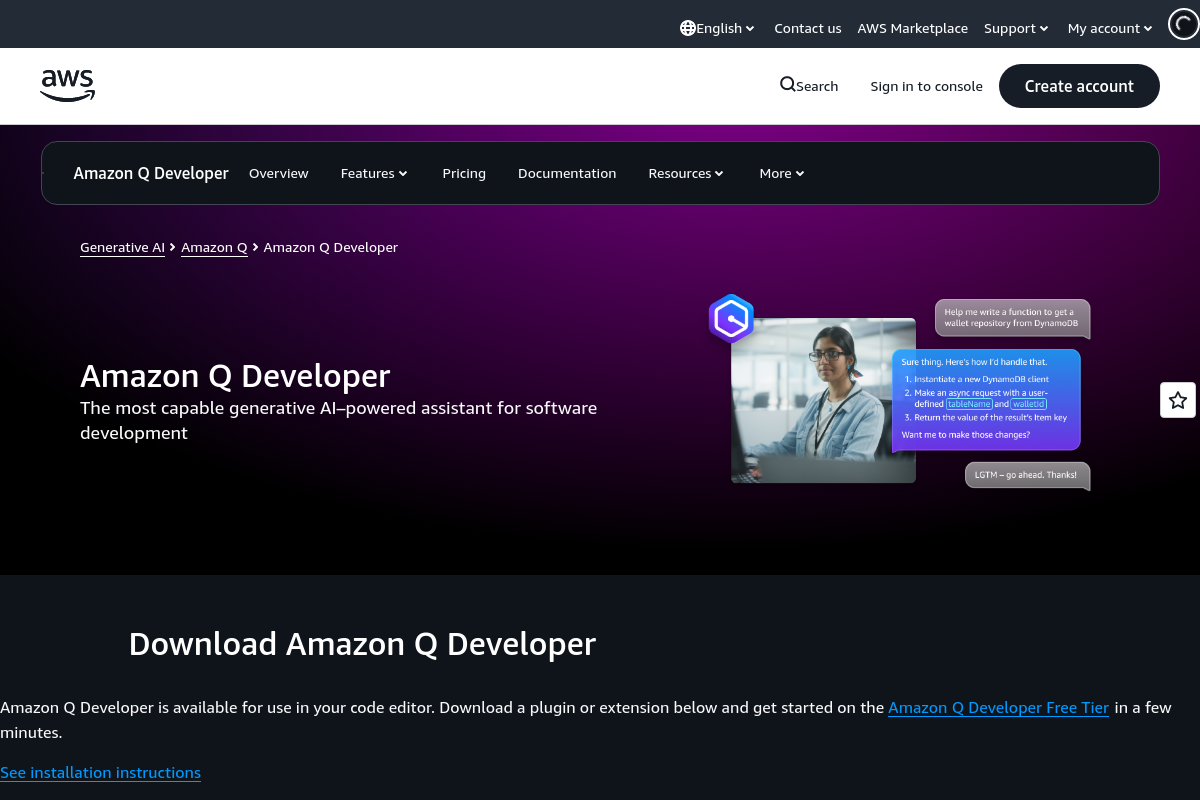
The overview
What Amazon CodeWhisperer is for
1Core Capabilitie
- Inline code completion suggestion
- Comment-to-code generation
- Unit test case scaffolding
- Security vulnerability scanning panel
- Reference code attribution display
2Specialized Workflow
- Multi-language and framework support (Python, Java, JavaScript, C#, Go, Rust, PHP, Ruby, Kotlin, C, C++, Shell Scripting, SQL, TypeScript)
- IDE integration via plugin marketplace (VS Code, IntelliJ IDEA, AWS Cloud9, JupyterLab, Amazon SageMaker Studio)
- License compliance filtering for generated code
- Customization for internal codebases (CodeWhisperer Customizations)
- Telemetry and usage metrics dashboard
Who it helps
Useful ways to use Amazon CodeWhisperer
A practical path
Activate Service via AWS Console
Navigate to the section within the AWS Management Console. Enable the service for your AWS account or organization. Configure organizational settings, including data sharing preferences and reference code filtering policies, directly from the browser-based interface
External signals
Reviews & reputation
Aggregated review score
Developers praise CodeWhisperer for its effective boilerplate reduction, context-aware suggestions, and integrated security scanning. Its utility for accelerating development in AWS environments and its robust license compliance features are frequently highlighted. Some users note occasional irrelevant suggestions, but overall, it's considered a valuable tool for enhancing developer productivity and code quality.
Quick answers
Frequently asked questions
1What is the pricing model for Amazon CodeWhisperer?⌄
CodeWhisperer offers a Free Tier for individual developers, providing unlimited code suggestions and 50 security scans per month. The Professional Tier, designed for organizations, includes advanced administrative features, organizational policy management, and CodeWhisperer Customizations, billed per user per month.
2How does CodeWhisperer handle data privacy and intellectual property for generated code?⌄
For the Professional Tier, organizations can opt out of having their code used to improve CodeWhisperer's underlying models. The service also includes a 'reference tracker' that flags code suggestions similar to publicly available open-source code, providing the repository URL and license, allowing developers to make informed decisions about intellectual property and license compliance.
3Can CodeWhisperer be customized to understand an organization's internal codebases and style guides?⌄
Yes, with CodeWhisperer Customizations (available in the Professional Tier), organizations can fine-tune the service on their private code repositories. This allows CodeWhisperer to generate suggestions that align with specific internal APIs, libraries, and coding conventions, improving relevance and consistency for proprietary projects.
4What are the primary differences between CodeWhisperer and other AI code generation tools like GitHub Copilot?⌄
Key differentiators include CodeWhisperer's deep integration with the AWS ecosystem, its built-in security scanner for identifying vulnerabilities, and its reference tracker for open-source code attribution. While both offer inline code suggestions, CodeWhisperer's focus on enterprise-grade features like organizational policy management and private codebase customization sets it apart for AWS-centric development teams.
5Which programming languages and IDEs are supported by CodeWhisperer?⌄
CodeWhisperer supports a broad range of languages including Python, Java, JavaScript, C#, Go, Rust, PHP, Ruby, Kotlin, C, C++, Shell Scripting, SQL, and TypeScript. It integrates with popular IDEs such as VS Code, IntelliJ IDEA, AWS Cloud9, JupyterLab, and Amazon SageMaker Studio via the AWS Toolkit plugin.
Keep exploring