

What Is Amazon SageMaker Ground Truth Used For: Features, Reviews & Alternatives
Data labeling service within AWS SageMaker.
Editorially updated Oct 5, 2025
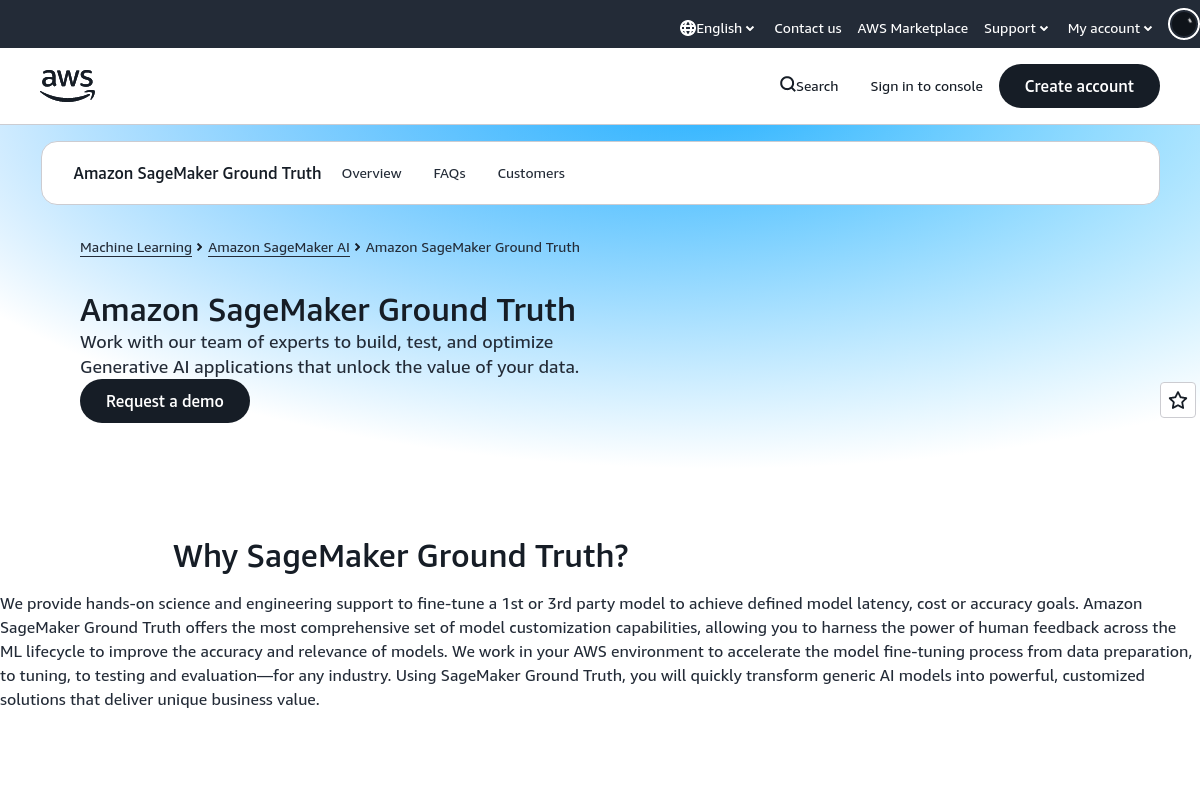
The overview
What Amazon SageMaker Ground Truth is for
1Core Capabilitie
- Image and video annotation task setup
- Private, vendor, and Amazon Mechanical Turk workforce integration
- Labeling job creation and management console
- S3 data input/output configuration for dataset
2Specialized Workflow
- Active learning for automated data labeling
- Customizable labeling instructions editor
- Consensus-based quality control mechanism
- Bounding box, polygon, and keypoint annotation tool
Who it helps
Useful ways to use Amazon SageMaker Ground Truth
A practical path
Configure a New Labeling Job
Navigate to the SageMaker console, select "Ground Truth" from the left navigation, and choose "Labeling jobs." Click "Create labeling job," specify your S3 input data location, and select the desired computer vision task type (e.g., "Object detection")
External signals
Reviews & reputation
Aggregated review score
A robust, scalable data labeling service within AWS SageMaker, highly valued by ML engineers for its integration with the AWS ecosystem and support for diverse computer vision annotation tasks. While powerful, its initial setup can be complex, and cost management requires careful monitoring.
Quick answers
Frequently asked questions
1How is Ground Truth priced, and what factors influence the cost for computer vision tasks?⌄
Ground Truth pricing is primarily based on the number of data objects processed and the type of labeling task. For image and video tasks, you're charged per image or frame labeled, with costs varying by task complexity (e.g., bounding box vs. semantic segmentation) and the workforce type chosen (private, vendor, or Mechanical Turk). Data transfer and S3 storage costs are separate.
2Can I use my own in-house team of annotators for sensitive computer vision data?⌄
Yes, Ground Truth supports using a "Private workforce." You can invite your own internal annotators via email, and they will access the labeling tasks through a secure web portal. This is ideal for proprietary or highly sensitive image and video datasets that cannot be exposed to external workforces.
3What types of computer vision annotation tasks does Ground Truth support out-of-the-box?⌄
Ground Truth provides built-in annotation tools for common computer vision tasks including image classification, object detection (bounding boxes), semantic segmentation (pixel-level masks), instance segmentation (polygons), and keypoint detection. It also supports custom templates for more specialized needs.
4How does Ground Truth help ensure the quality of the labeled data, especially for complex image annotations?⌄
Ground Truth offers several quality control mechanisms. You can configure multiple labelers to annotate the same data object and use consensus to determine the final label. Additionally, you can set up review workflows where a subset of labeled data is sent to a higher-skilled reviewer for verification and correction before final approval.
5Is it possible to integrate Ground Truth labeling jobs directly into my existing MLOps pipeline?⌄
Absolutely. Ground Truth integrates seamlessly with other AWS services. You can programmatically create and manage labeling jobs using the AWS SDKs or CLI, trigger jobs based on new data arriving in S3, and consume the output manifest files directly into SageMaker training jobs or other downstream model development processes, enabling automated data labeling loops.
Keep exploring